Skip to the content


Why Local Businesses Need to Monitor How They Show Up in AI Search
October 5, 2026
7 minute read
Consistent, accurate business information has long been a foundation of local SEO. AI-powered search adds another responsibility: checking what customers are actually being told about your business.
AI assistants and search overviews pull information from websites, business listings, reviews, and other sources to generate answers. Your website, Google Business Profile, and Yelp listing can all be correct, and the answer a customer receives can still get your information wrong.
Customers will likely accept those answers without questioning them. For local businesses, that raises a practical concern: customers acting on incorrect information without ever checking your website.
Where AI Answers Go Wrong
AI-generated answers often combine information from a company’s website, business profiles, directories, reviews, and other sources. When those sources conflict, AI may:
- Surface outdated contact details, hours, or pricing
- Misrepresent a service or offering
- Confuse one business with another
- Misstate how to contact, schedule, purchase, or take the next step
Accuracy can also suffer when important details are missing, difficult to find, or buried inside images, PDFs, scripts, or embedded tools. Even when the available information is correct, AI may infer something the source never said or combine unrelated details. Consistency cannot guarantee an accurate answer, but it reduces ambiguity and gives these tools fewer opportunities to choose the wrong information.
Make Your Business Information Consistently Available
Keep Your Business Information in Sync
Manage your official business information in one place, either directly or through a listings management platform such as Yext, SOCi, or Birdeye. The listings management platform should distribute accurate, up-to-date information across the places customers and AI search tools rely on:
- Website
- Business profiles
- Maps
- Directories
- Review platforms
- Local and industry-specific directories
Understand Where AI Search Tools Find Local Business Information
AI Search Tools may obtain business information by crawling websites, consuming APIs, or licensing content from directories. That information can then feed:
- Bing
- ChatGPT
- Voice assistants
- Other AI and search experiences
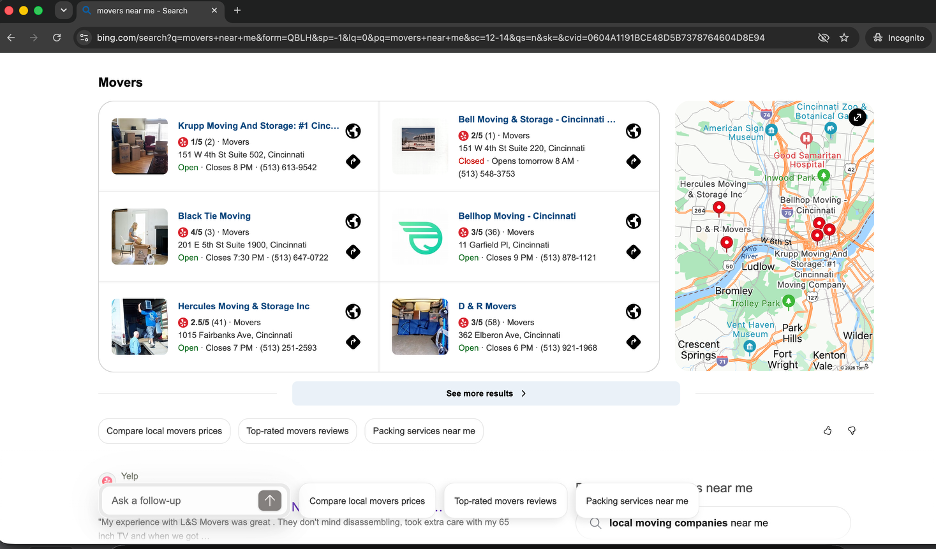
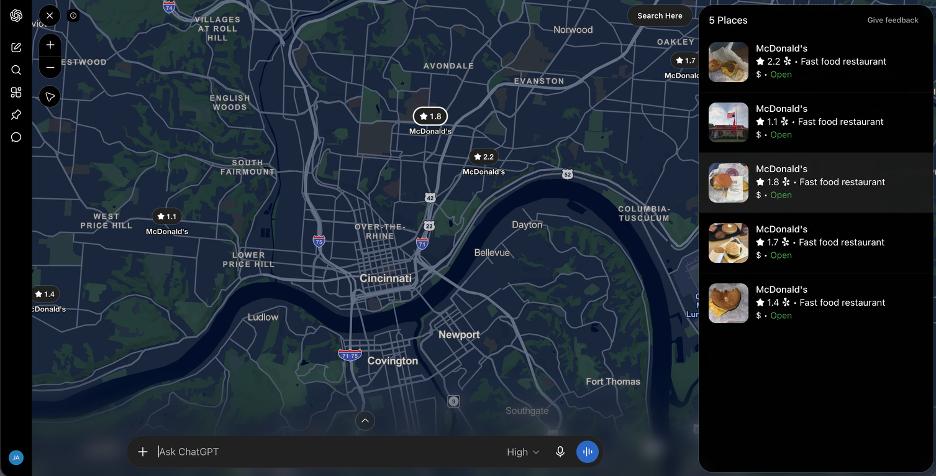
Yelp shows how this information can travel downstream: Microsoft Bing incorporates licensed Yelp content into local search, while Yelp’s partnership with OpenAI brings its ratings, reviews, photos, and other business information into ChatGPT’s local experience.
Customers ultimately encounter that information in search results, maps, voice assistants, and AI-generated answers, including:
- Hours
- Pricing
- Services
- Locations
- Contact information
- Appointment and scheduling information
Make Your Website Easy to Interpret
Pages need an obvious purpose. For example, a “Contact Us” page should be distinct from “Request a Consultation.” Make each page easy to understand by using descriptive:
- Titles
- Headings
- Internal links
- Calls to action
Keep essential information in the server-rendered HTML instead of loading it only through JavaScript because many major AI crawlers do not execute JavaScript.
Reinforce essential information with structured data, including your business name, address, phone number, hours, URLs, and official profiles. Ensure the structured data matches what users see on the page.
Use clear, accessible page elements (such as descriptive links and properly labeled forms) to reduce ambiguity for both users and AI systems.
Add AI Search Visibility to Your SEO Monitoring
Expand SEO audits beyond rankings and listing accuracy. Regularly test questions customers may ask about your hours, pricing, services, locations, and appointment options. Check several AI search experiences and compare desktop and mobile, browser and app, or signed-in and signed-out results.
Example queries
- how much does [service/product] cost at [business name]?
- does [business] have [service/product]?
- where can I buy and pickup [service/product] today?
- what [business type]s around [insert area/me] take walk-ins?
- does the [product plan] from [business name] cover [customer need]?
- [business type]s around [insert area/me] open on Sundays
When an error appears, record the query, answer, date, platform, cited sources, and a screenshot. Identify conflicting or unclear information, correct the sources you control, and then retest.
Focus on What You Can Control
Businesses cannot completely control what AI platforms generate, but they can improve the signals those systems rely on by keeping business information consistent, strengthening first-party content, maintaining local listings, and monitoring how AI represents the brand.
As the disclaimers on your favorite AI tool acknowledge, AI can make mistakes, but those warnings do not prevent customers from acting on incorrect answers.

This is a brave new world and due diligence is required to make sure your clients, customers, and prospects have the best chance possible to get the information they need in the tools they’re using.

Senior Marketing: Bringing Clarity; The Power of Advanced Analytics
In the world of senior living marketing, data is king—or so we’re led to believe. Digital and CRM platforms churn out numbers that promise to...
DuckDuckGo: Shiny Object or Search Engine Evolution?
Background For as long as the Internet has been widely accessible, Google has dominated the search engine market. Google’s success dates back to...